Skip to Main Content
Printer Friendly Home > Issues > Rape in War

Program on Sexual Violence in Conflict Zones

Sita Kimya -


Every year, tens of thousands of women, girls, men, and boys endure sexual violence during and after armed conflict. The crisis is acute in many countries around the world, including those where the International Criminal Court (ICC) is currently investigating mass atrocities: Central African Republic (CAR), Democratic Republic of the Congo (DRC), Kenya, Sudan, and Uganda.

Government and civil society organizations recognize that permitting perpetrators of sexual violence to escape punishment results in elusive justice and ineffective reparation for survivors. Ending impunity must be at the core of any systematic response to this crisis.

As efforts to support legal redress for survivors of mass rape intensify in these countries, Physicians for Human Rights (PHR), working with many local partners in the region, has identified an area where our skills and experience can make a vital contribution to the abilities of health and legal communities to build prosecutions of sexual violence crimes.

Health professionals are crucial first responders to rape survivors, yet many receive little training in the forensic collection and documentation of evidence. Additionally, police, lawyers, and judges seek support to assess sexual violence and effectively interact with health workers and survivors.

Sexual Violence Forensic Medical Evaluation Training
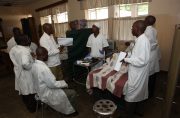
PHR medical experts Dr. Coleen Kivlahan and Dr. Ranit Mishori train Congolese health care providers to conduct forensic medical evaluations for sexual violence survivors in Bukavu, DRC.

To address these needs, PHR launched a multi-year training and advocacy initiative in 2011, with the aim of forging coalitions among regional medical, law enforcement, and legal experts in the above countries. Our goal is to dramatically increase local capacity for the collection of court-admissible evidence of sexual violence to support prosecutions for these crimes.

The Program on Sexual Violence in Conflict Zones draws on PHR’s extensive expertise in documenting war crimes and providing forensic training to professionals in regions of conflict where mass crimes have been committed. Specifically, the program is conducting a series of cross-sectoral, collaborative training workshops for members of the health care, law enforcement, and legal communities.

Through these workshops, the Program on Sexual Violence in Conflict Zones:

  • works with local experts to train doctors, nurses, and psycho-social trauma and recovery counselors in the collection of forensic evidence of sexual violence, including documenting health consequences, assuring appropriate treatment, and supporting legal assistance and advocacy;
  • provides a forum for essential cross-training and professional collaboration in serving survivors’ needs;
  • connects members of the health, law enforcement, and legal sectors to facilitate an informal regional support network among stakeholders working to combat sexual violence;
  • advocates for national and international reforms addressing the political, legal, social, and cultural obstacles that often derail efforts toward prosecution; and
  • supports the ICC and other international and local legal processes in their efforts to prosecute the highest-level perpetrators of mass atrocities in these countries.

In addition to strengthening the capacity of each of these sectors to respond to sexual violence, PHR’s initiative aims to raise the profile of nurses documenting evidence, reduce professional isolation, increase communication, and facilitate dialogue across the medical, law enforcement, and legal communities.

To accomplish its goals, PHR has brought together a wide-ranging network of local and international experts, including doctors, nurses, police officers, forensic experts, lawyers, and judges. These and other partners have helped to develop the training materials and lead the workshops aimed at defining and implementing forensic best practices over the long term.

PHR’s training model is designed with a view toward long-term capacity building and sustainability, as graduates of our training program will be well-positioned to then train their colleagues and counterparts in subsequent workshops.

By working on a systemic level, forging new coalitions across sectors, and bolstering capacity for local prosecutions we can help strengthen accountability mechanisms for sexual violence in East and Central Africa. Ending the culture of impunity will be crucial in deterring future crimes and enabling survivors to obtain a measure of justice.

To date, PHR has:

  • convened basic and advanced forensic training workshops in DRC (Goma, North Kivu, and Bukavu, South Kivu), and in Kenya (Nairobi, Eldoret, and Kisumu) and elsewhere;
  • trained more than 248 service providers from the health, law enforcement, and legal sectors;
  • launched cross-sectoral networks of local professionals in DRC and in Kenya; and
  • developed and deepened local partnerships over the last two years to facilitate communication, coordination, and collaboration among health, law enforcement, and legal service providers.
Sexual Violence Forensic Medical Evaluation Training DRC
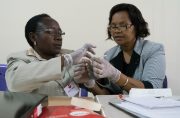
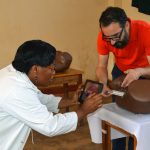
A Kenyan police officer practices evidence and chain of custody labeling.

In February 2013, PHR was awarded first prize for its mobile forensic application, MediCapt, in the USAID-Humanity United Tech Challenge for Atrocity Prevention competition. PHR’s technology, in collaboration with Magpi and InformaCam, will equip clinicians with critical tools for collecting, documenting and preserving court-admissible forensic evidence of mass atrocities including sexual violence and torture.

PHR’s Expertise on Documenting Mass Rape and Forensic Evidence Collection

PHR has longstanding experience in forensic investigations and advocacy to end rape in armed conflict. For more than twenty years, PHR has conducted pioneering research and advocacy on this issue, including in its landmark studies in Bosnia, Sierra Leone and Sudan/Chad. From 2004-2006, PHR coordinated a successful training series in Sudan, in Khartoum and Nyala, Darfur, on documenting torture, sexual violence against women and other forms of abuse. The ICC cited PHR’s documentation of war crimes in Darfur in its 2009-2010 proceedings.

Additionally, PHR’s forensic trainings around the world based on the Istanbul Protocol (UN standard for documentation of torture that PHR initiated and co-authored) have resulted in improved practices in many countries supporting accountability for torture and/or sexual violence. PHR’s forensic courses in crime scene investigation and evidence documentation, and in forensic laboratory services and medical examiner’s office operations, have also drawn global participants.

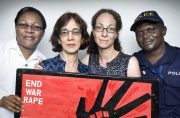
PHR is a founding member and advisory committee member of the new International Campaign to Stop Rape & Gender Violence in Conflict. Read more and sign the pledges to help stop rape in war.

Through all these initiatives, PHR has developed a refined understanding of trauma experienced by sexual violence survivors in conflict and their complex needs, including for comprehensive justice.

The PHR Team

Karen Naimer, JD, LLM, MA

Director of the Program on Sexual Violence in Conflict Zones, is responsible for spearheading PHR’s training, research and advocacy initiatives, and brings to the program more than 15 years of experience in international criminal law, international humanitarian law, human rights, national security, and anti-corruption. Among her previous positions, she clerked for the President of the International Criminal Tribunal for the Former Yugoslavia and served as Deputy Counsel at the Independent Inquiry Committee into the United Nations Oil-For-Food Programme (“the Volcker Commission”), where she worked with a global network of prosecutors and investigated widespread corruption among the most senior UN personnel and Security Council member states.

Other PHR team members include:

  • Susannah Sirkin, MEd, Director of International Policy and Partnerships
  • Caroline Dauber, MPH, MS, DRC Program Coordinator
  • Rachel Muthoga, LLB, LLM, Kenya Program Coordinator
  • Kelly Bienhoff, MA, Program Associate
  • Elena Moroz, MPH, Administrative Coordinator
  • Désiré Alumeti, MD, Medical Consultant
  • Nancy Cabelus, DNP, MSN, RN, Forensic Consultant
  • Michele Curtis, MD, MPH, MML, Medical Consultant
  • Hope Ferdowsian, MD, MPH, Medical Consultant
  • Coleen Kivlahan, MD, MSPH, Medical Consultant
  • Joan Nyanyuki, MD, MSc, Medical Consultant