
Physicians for Human Rights
Using science and medicine to stop human rights violationsAsylum
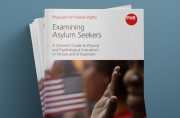
Examining Asylum Seekers: A Clinician's Guide to Physical and Psychological Evaluations of Torture and Ill Treatment - manual now available! Click here for more information and to order.
Attorneys: To request an evaluation for your client, please fill out the forensic evaluation request form (pdf) and send to PHR via fax (617.301.4250) or email (asylum [at] phrusa [dot] org).
For more than twenty years, PHR has been at the forefront of protecting the right to live in safety. The Asylum Program’s unique model provides direct service to asylum seekers, advocates for improved conditions in US immigration detention centers, and documents human rights abuses that immigrants suffer in their home countries and in US care.
Asylum Network: Proving Human Rights Abuses
Hundreds of volunteer health professionals in our Asylum Network have helped thousands of survivors of torture and other brutal forms of persecution gain asylum in the US by providing them with medical evaluations to prove they were victims of persecution. One of PHR’s evaluators has shared her experience providing evaluations for asylum seekers, in this article for The American Psychological Association.
Advocacy: Improving Conditions in US Detention Centers
PHR seeks to protect survivors of persecution by working with federal and state policymakers to elevate the quality and timeliness of health care provided in immigration detention centers, to reduce the overall use of immigration detention, and to eliminate arbitrary and unjustified barriers to attaining humanitarian protection in the US.
Documenting Human Rights Abuses
Asylum seekers face persecution in both their countries of origin and in immigration detention centers. Our goal is to discover those abuses, highlight them, and bring about justice and change.
Examining Asylum Seekers: A Health Professional's Guide to Medical and Psychological Evaluations of Torture
PHR’s manual provides medical professionals with the information necessary to conduct potentially life-saving evaluations. Includes an overview of political asylum law and procedure in the United States, an explanation of the physician's role in verifying signs and symptoms consistent with torture, and a review of components of appropriate written and oral medical testimony.
Fact sheets on Asylum
PHR has written several fact sheets on various aspects of asylum, asylum law, immigration detention, and more. These PDFs made for printing can be found here.
Evaluating Asylum Seekers: An Interview with Dr. Arno Vosk (SampsoniaWay.org, May 9, 2013)
Asylum Network volunteer Dr. Vosk discusses the role coincidence plays in keeping asylum seekers alive, his method of assessing trauma via an individual’s scars, and the difficulties people face when seeking refuge in the US, where “fearfulness and rejection of immigrants have become an accepted part of national policy.”
Dr. Eddy Ameen, Asylum Network Volunteer (SampsoniaWay.org, May 7, 2013)
Sampsonia Way speaks to Dr. Eddy Ameen, a licensed professional counselor who works as a volunteer in Physicians For Human Rights’ Asylum Network program.
Evaluating Asylum Seekers (SampsoniaWay.org, May 1, 2013)
Sampsonia Way is launching a series of interviews with physicians that donate their time to The Asylum Network of Physicians for Human Rights. Today we present what the organization does and some of the experiences of one of PHR’s volunteers in providing evaluations for asylum seekers.
Free Guantánamo Detainees Who Are Cleared for Release (April 10, 2013)
As a hunger strike by dozens of detainees held at Guantánamo Bay enters its third month, PHR calls on President Obama to take immediate steps to free those who have been cleared for release and to treat remaining detainees in conformance with ethical guidelines and international law.
More Asylum Network News »
Failing to Heal: Hunger Strikes in Guantánamo and the Role of Medical Professionals (April 30, 2013)
In a recently released bipartisan report on detainee treatment at the detention facility in Guantánamo Bay, Cuba, the Constitution Project’s Expert Task Force devotes a whole chapter to the spectacular failure of medical professionals in GTMO to protect detainees from harm or injustice.
Obama 2.0: Will Plans for immigration Reform Address Needs of the Most Vulnerable? (November 29, 2012)
There is a broad consensus that our immigration system is in desperate need of an overhaul. Comprised of a hopelessly complicated patchwork of laws enacted in response to events like the 1993 World Trade Center bombings and the 9/11 attacks, the immigration system creates narrow pathways for some immigrants to come to or remain in the United States, while making it almost impossibly hard for others, including many fleeing torture and persecution.
Massachusetts Supreme Judicial Court Limits Solitary Confinement (November 28, 2012)
The Massachusetts Supreme Judicial Court yesterday ruled that holding an inmate for 10 months in solitary confinement with only periodic informal review of his custody was unlawful. ... While stopping short of prohibiting the use of solitary confinement, the court’s ruling firmly establishes that inmates are entitled to a mechanism for challenging their placement in solitary.
Medicine Meets the Law: When a Psychological Evaluation Means the Difference between Asylum and Deportation (November 8, 2012)
When people make the decision to escape the torture and persecution they’ve suffered in their home countries by fleeing to the US, many have no idea that they have only one year from the time they arrive to apply for asylum.
More Asylum Network Posts »
Buried Alive: Solitary Confinement in the US Detention System (April 2013)
Solitary confinement is a form of segregation in which people are held in total or near-total isolation in small cells for 23 hours a day. It is used to control and discipline detainees in federal and state prisons, local jails, and immigration and national security detention facilities. Unlike incarcerated prisoners, immigration and national security detainees are held not as punishment for a crime but as a preventive measure, and will likely never be charged with a crime. For these people, solitary confinement then becomes entirely punitive, with dire consequences for their mental and physical health.
Examining Asylum Seekers (December 2012)
Clinicians can assist asylum seekers and others seeking protection in the United States by providing objective documentation of their physical and psychological injuries and trauma. This documentation becomes evidence that can corroborate the asylum seeker’s narrative of persecution. This manual is a tool for clinicians to use in assisting their evaluation and documentation of asylum seekers' histories. PHR intends to provide medical professionals with the information necessary to conduct these potentially life-saving evaluations by including an overview of political asylum law and procedure in the United States, an explanation of the physician's role in verifying signs and symptoms consistent with torture, and a review of components of appropriate written and oral medical testimony.
Invisible in Isolation (September 2012)
Immigrants in detention facilities around the United States are often subjected to punitive and long-term solitary confinement and denied meaningful avenues of appeal, according to an investigation by PHR and Heartland Alliance’s National Immigrant Justice Center (NIJC).
Supreme Court Allows Racial Profiling Provision in Arizona Immigration Law to Stand (June 2012)
Today the Supreme Court struck down three provisions of Arizona’s controversial immigration law, commonly known as SB 1070. While the Court unanimously upheld a provision requiring state law enforcement agents to determine the immigration status of any person they stop if they have “reasonable suspicion” that the person is in the US illegally, the Court left the door open for future challenges to that provision.
More Asylum Network Research »
Our Work
Invisible in Isolation
Immigrants in detention facilities around the United States are often subjected to punitive and long-term solitary confinement and denied meaningful avenues of appeal, according to an investigation by PHR and Heartland Alliance’s National Immigrant Justice Center (NIJC). Read More »
Related Profiles

Coleen Kivlahan MD, MSPH
Dr. Kivlahan is a long-time family medicine practitioner, and an Asylum Network volunteer and trainer. She also provides child sexual and physical abuse evaluations, and rape evaluations for women of all ages. Read More »